

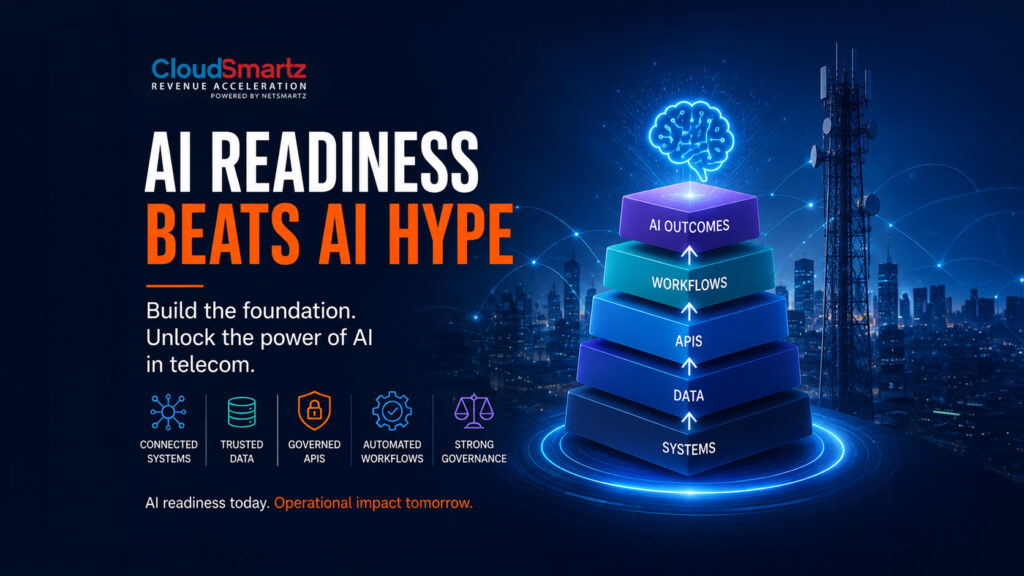
AI Readiness for Telcos: Why Readiness Beats AI Hype
Artificial intelligence has become one of the biggest priorities for communications service providers (CSPs). Every industry event, analyst report, and technology roadmap highlights AI as the next competitive advantage. From AI-powered customer support and predictive network assurance to intelligent service orchestration and automated revenue management, the opportunities appear limitless.
Yet despite increasing investment, relatively few telecom operators have successfully deployed AI at scale.
The reason isn’t a lack of AI innovation. Foundation models are more capable than ever, enterprise AI platforms continue to mature, and purpose-built telecom AI solutions are rapidly entering the market.
The challenge lies elsewhere.
Successful AI initiatives depend on operational foundations that many telecom environments simply weren’t designed to provide. Fragmented OSS/BSS systems, inconsistent data, disconnected APIs, and manual workflows prevent AI from moving beyond isolated proof-of-concept projects.
In other words, AI success isn’t determined by choosing the right model. It’s determined by how prepared your organisation is to support AI across people, processes, data, and technology.
This is where AI readiness becomes the real competitive differentiator.
What Is AI Readiness for Telcos?
AI readiness is the ability of a telecom organisation to support AI-driven operations through interoperable systems, trusted data, governed APIs, automated workflows, and strong operational governance.
Rather than viewing AI as another software deployment, AI-ready organisations focus on building an architecture where intelligence can access reliable information, automate decisions, and orchestrate business processes across the entire OSS/BSS ecosystem.
An AI-ready telco architecture enables operators to:
- Connect OSS, BSS, CRM, billing, inventory, and network systems through standardised APIs.
- Deliver trusted, high-quality data to AI applications.
- Automate workflows across fulfilment, assurance, and customer operations.
- Govern AI decisions through observable and auditable processes.
- Scale new AI use cases without creating additional integration complexity.
Without these capabilities, AI remains limited to isolated experiments rather than enterprise-wide transformation.
Why AI Projects Stall in Telecom
Across the telecom industry, AI initiatives typically begin with high expectations.
Operators launch pilots to improve customer service, automate network operations, optimise revenue, or accelerate service delivery. In controlled environments, many of these projects demonstrate encouraging results.
However, once those same initiatives move towards production, progress often slows dramatically.
The issue is rarely the AI model itself.
Instead, the model encounters operational environments where data is fragmented, systems operate independently, and workflows rely on manual intervention.
Consider a typical telecom landscape.
Customer information may exist across CRM platforms, billing systems, self-service portals, and support applications.
Inventory data may be spread across network inventory, logical inventory, service inventory, and legacy operational databases.
Product catalogues, order management systems, fulfilment platforms, and assurance tools often maintain their own business logic and data structures.
Each system performs its intended function, but together they create an environment where AI struggles to establish a complete operational picture.
As a result, organisations experience familiar challenges:
- AI recommendations are based on incomplete or conflicting data.
- Automation stops at system boundaries because workflows remain manual.
- New AI use cases require additional custom integrations.
- Business users lose confidence when AI produces inconsistent outcomes.
These challenges are architectural—not algorithmic.
The Hype Cycle Isn’t the Problem—The Readiness Gap Is
The excitement surrounding AI is not necessarily a problem.
In many organisations, it has accelerated executive sponsorship, increased investment, and encouraged innovation across business units.
The real challenge emerges when organisations focus exclusively on AI models while overlooking the operational environment those models depend on.
A familiar pattern begins to emerge.
The Pilot Delivers Promising Results
During early testing, AI performs well.
Data has been carefully prepared, integrations are tightly controlled, and the use case focuses on a single operational domain.
Stakeholders gain confidence that AI can deliver measurable value.
Production Introduces Operational Complexity
As organisations expand the same solution into production, AI must interact with multiple OSS/BSS platforms, customer systems, network inventories, fulfilment processes, and assurance workflows.
This is where the challenges begin.
Different systems expose different APIs.
Data definitions vary across platforms.
Manual approvals interrupt automated workflows.
Legacy integrations become bottlenecks.
The AI model hasn’t changed.
The operating environment has.
The Wrong Conclusion
When AI initiatives stall, organisations often assume they need a larger model, more training data, or a different AI vendor.
In reality, the technology is rarely the limiting factor.
The real issue is that the underlying architecture was never designed to support AI-driven operations at scale.
Improving AI outcomes begins with improving operational readiness.
The Five Pillars of AI Readiness
Building an AI-ready telecom organisation requires more than deploying new technology.
It requires strengthening the operational foundations that allow AI to deliver reliable, scalable business outcomes.
Five capabilities consistently distinguish organisations that successfully operationalise AI from those that remain trapped in perpetual pilot programmes.
1. System Interoperability
Artificial intelligence depends on connected systems.
Customer management, billing, OSS, BSS, inventory, service orchestration, fulfilment, assurance, and partner platforms must exchange information through governed, standards-based interfaces.
When systems remain isolated, AI can only optimise individual silos rather than end-to-end business processes.
Interoperability enables AI to correlate information across operational domains, providing richer context for decision-making while reducing integration complexity.
Industry standards such as TM Forum Open APIs, MEF Lifecycle Service Orchestration (LSO), and CAMARA Network APIs provide a consistent framework for exposing business capabilities without creating additional technical debt.
2. Data Quality and Lineage
AI is only as reliable as the data it consumes.
In many telecom environments, customer records, inventory information, service data, and operational metrics exist across multiple platforms. Each system may use different identifiers, update schedules, and business rules, making it difficult to establish a single source of truth.
AI cannot distinguish between trusted and inconsistent data unless those governance mechanisms already exist.
An AI-ready organisation focuses on creating trusted, well-governed data by ensuring:
- Data is accurate and consistent across systems.
- Information is traceable from source to destination.
- Data ownership and stewardship are clearly defined.
- Access is governed through appropriate security and compliance controls.
- Information is updated in near real time where operational decisions depend on it.
Strong data governance not only improves AI outcomes but also enhances reporting, operational visibility, and executive decision-making across the business.
3. API Governance
As telecom ecosystems continue to expand, APIs have become the primary mechanism for connecting applications, partners, and digital channels.
However, simply exposing APIs is not enough.
Without governance, organisations quickly accumulate duplicate APIs, inconsistent versions, security risks, and undocumented integrations that become increasingly difficult to maintain.
An AI-ready telecom platform requires APIs that are:
- Discoverable
- Secure
- Version controlled
- Monitored
- Well documented
- Lifecycle managed
Aligning APIs with industry standards such as TM Forum Open APIs, MEF Lifecycle Service Orchestration (LSO), and CAMARA Network APIs enables operators to reduce integration complexity while creating reusable services that support future AI initiatives.
Governed APIs also allow AI applications to interact with business capabilities consistently, eliminating the need for custom integrations every time a new use case is introduced.
4. Workflow Orchestration
AI recommendations create value only when they lead to action.
If service activation, incident resolution, fulfilment, or customer support still rely on manual handoffs between systems, AI becomes an advisory tool rather than an operational capability.
An AI-ready organisation connects decision-making with execution through workflow orchestration.
This enables AI to support processes such as:
- Intelligent order fulfilment
- Automated service provisioning
- Predictive network assurance
- Incident prioritisation
- Revenue assurance
- Customer support automation
By orchestrating workflows across OSS/BSS domains, telecom operators can reduce manual intervention, shorten fulfilment cycles, and improve operational consistency.
5. Use-Case Governance
Not every AI initiative deserves investment.
Successful telecom operators evaluate potential AI use cases based on operational feasibility, business value, implementation complexity, and measurable outcomes before development begins.
Questions that should guide every AI initiative include:
- Is the required data available and trusted?
- Can existing systems expose the required business capabilities?
- Are APIs available and governed?
- Can workflow execution be automated?
- How will success be measured?
This disciplined approach helps organisations prioritise initiatives that deliver measurable value while avoiding expensive experiments that never reach production.
Why AI Readiness Is a Business Strategy
AI readiness is often viewed as a preliminary phase before “real” AI implementation begins.
In practice, the readiness work delivers business value long before the first AI model enters production.
For example:
- Standardised APIs reduce integration costs and accelerate partner onboarding.
- Unified data improves operational reporting and business intelligence.
- Automated workflows shorten service fulfilment cycles and reduce manual effort.
- Governed integration lowers technical debt and simplifies future transformation programmes.
- Standardised platforms improve organisational agility regardless of which AI technologies are adopted.
Viewed this way, AI readiness is not simply preparation for AI.
It is a broader digital transformation strategy that strengthens operational efficiency, improves customer experience, and reduces long-term technology risk.
The Cost of Skipping AI Readiness
Organisations that prioritise AI deployment without first addressing architectural readiness often experience predictable outcomes.
Readiness Gap | Business Impact |
Fragmented OSS/BSS systems | AI cannot build a complete operational view across business domains. |
Inconsistent data | AI recommendations become unreliable and require manual validation. |
Ungoverned APIs | Every new AI initiative requires additional custom integrations. |
Manual workflows | AI insights cannot trigger automated operational actions. |
Poor governance | AI investments become fragmented across disconnected pilot projects. |
The cost extends beyond unsuccessful pilots.
It results in increased integration debt, slower innovation, higher operational costs, and declining executive confidence in AI-led transformation.
Preparing the organisation before scaling AI significantly reduces these risks while improving long-term return on technology investment.
How CloudSmartz Enables AI Readiness
CloudSmartz helps communications service providers establish the operational foundation required for enterprise AI adoption.
Rather than replacing existing OSS/BSS investments, the Acumen360 platform connects customer experience, product management, quoting, fulfilment, assurance, and partner ecosystems into a unified, standards-based architecture.
This enables operators to modernise incrementally while preparing their business for AI-driven operations.
Acumen360 combines capabilities including:
- Acumen UXP for digital customer experiences
- Acumen CPQ for intelligent product configuration and quoting
- Acumen SDX for service fulfilment and orchestration
- Carrier Connect for standards-based API integration
- API Marketplace for API governance and monetisation
- Observability Manager for operational visibility and performance monitoring
Together, these capabilities create a connected platform where AI can securely access trusted information, orchestrate business processes, and automate operational workflows.
Combined with CloudSmartz’s AI Enablement Layer and Custom Development & System Integration expertise, organisations can:
- Assess AI readiness across architecture, data, APIs, and governance.
- Prioritise high-value AI use cases.
- Modernise existing OSS/BSS environments through a phased approach.
- Reduce integration complexity using industry standards.
- Deploy AI with greater confidence and lower operational risk.
Rather than chasing the latest AI trend, CloudSmartz helps telecom operators build the foundation that enables AI to scale successfully.
Build the Foundation Before Scaling AI
The telecom industry does not have an AI innovation problem.
It has an AI readiness challenge.
The organisations achieving the greatest value from AI are not necessarily those investing in the largest models or the newest platforms. They are the organisations strengthening the operational foundations that allow AI to perform consistently across the business.
Interoperable systems.
Trusted data.
Governed APIs.
Automated workflows.
Observable operations.
These capabilities transform AI from isolated experimentation into sustainable operational value.
As AI adoption accelerates across the telecom industry, readiness will increasingly separate organisations that successfully scale innovation from those that remain trapped in endless pilot programmes.
The future belongs not to the organisations with the most AI—but to those that are truly ready for it.

2 Responses