

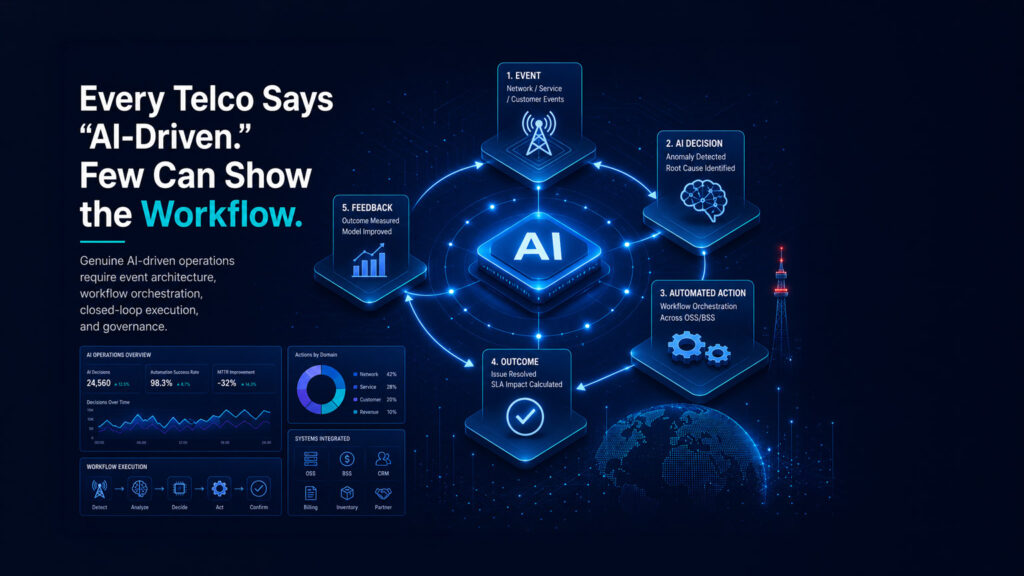
Every Telco Says “AI-Driven.” Few Can Show the Workflow.
The telecom industry has embraced AI at an unprecedented pace. Nearly every product announcement, transformation programme, and technology roadmap now includes terms such as AI-powered, AI-enabled, or AI-driven. From network operations and service assurance to customer experience and revenue management, AI has become the defining narrative for digital transformation.
Yet one simple question exposes the difference between marketing claims and operational reality:
Can you show the workflow?
Not the model architecture. Not the prompt engineering. Not the dashboard showing AI-generated insights. The complete operational workflow—from the event that triggers the AI, to the decision it makes, to the automated action it initiates, and finally to the measurable business outcome.
For many communications service providers (CSPs), that workflow is still incomplete.
An AI model identifies an anomaly. A recommendation appears on a dashboard. An engineer reviews it, logs into another system, creates a ticket, coordinates with another team, and manually executes the required action. The model is intelligent, but the business process remains manual.
That is AI-assisted, not AI-driven.
True AI-driven operations require more than intelligent models. They require an operational foundation that connects data, systems, APIs, workflows, and governance into a single, orchestrated execution layer.
In this blog, we’ll explore what genuinely AI-driven telecom operations look like, the capabilities required to achieve them, and how operators can move from isolated AI initiatives to measurable business outcomes.
The Difference Between AI-Assisted and AI-Driven Operations
Many organisations use the phrase AI-driven to describe any workflow that includes AI. In reality, there is a significant difference between AI providing recommendations and AI executing business processes.
Think of AI maturity as a progression.
AI Maturity | What It Looks Like |
AI-labelled | AI appears in product messaging, but no production AI exists. |
AI-informed | AI generates insights that employees review manually. |
AI-assisted | AI supports decisions, but people still execute every action. |
AI-automated | AI triggers limited automation within a single application or domain. |
AI-driven | AI orchestrates governed, cross-domain workflows and continuously measures outcomes. |
The distinction is important.
An AI model that predicts network congestion has limited value if someone still needs to manually coordinate multiple operational teams before corrective action begins.
Likewise, an AI-powered customer retention recommendation achieves little if sales representatives must manually retrieve customer information, prepare offers, and initiate follow-up activities across disconnected systems.
AI creates business value only when intelligence becomes action.
What Makes an AI Workflow Truly AI-Driven?
AI-driven operations are not defined by the sophistication of the model. They are defined by the operational capabilities surrounding it.
Every successful enterprise AI deployment depends on five foundational capabilities working together.
1. Event-Driven Architecture
AI cannot respond to events it never receives.
Modern telecom operations generate thousands of operational events every second—from network alarms and order updates to billing changes, customer interactions, and service performance metrics.
For AI to operate in real time, those events must be published through governed, standardised event streams rather than hidden inside isolated applications or batch processes.
An event-driven architecture enables systems to publish operational changes as they occur, allowing AI models to react immediately instead of waiting for scheduled integrations or manual intervention.
Characteristics of a mature event architecture
- Standardised event schemas across OSS and BSS systems
- Real-time event streaming instead of batch processing
- Governed event publishing and subscriptions
- Consistent entity identifiers across systems
- End-to-end event traceability
Without event-driven architecture, AI operates with incomplete or outdated information, making real-time automation impossible.
2. Workflow Orchestration
Detecting a problem is only the beginning.
Real business value comes from coordinating the response across multiple operational systems.
When AI identifies a service degradation, the workflow should automatically coordinate every downstream activity, including:
- Updating OSS platforms
- Creating service tickets
- Initiating remediation workflows
- Informing customer support teams
- Sending proactive customer notifications
- Updating operational dashboards
Without orchestration, AI simply creates more work for employees by generating recommendations that still require manual execution.
A workflow orchestration layer connects these activities into a governed process that spans multiple systems while maintaining visibility, consistency, and auditability.
Signs of mature orchestration
- Multi-system workflows execute automatically
- APIs connect systems instead of manual handoffs
- Workflows are version-controlled
- Retry and rollback mechanisms exist
- Every execution step is monitored
The difference between AI-assisted and AI-driven operations often comes down to one question:
Does AI trigger business workflows automatically, or does someone still need to click a button?
3. Closed-Loop Execution
Many AI initiatives stop after making a recommendation.
Production AI goes further.
Every action initiated by AI should be validated against its intended business outcome.
For example:
A network anomaly is detected.
↓
AI identifies the likely root cause.
↓
An automated remediation workflow executes.
↓
The affected service recovers.
↓
The platform confirms recovery.
↓
The result is recorded.
↓
Future AI decisions improve using that operational feedback.
This continuous feedback mechanism is known as closed-loop execution.
Without it, organisations cannot confidently answer fundamental questions such as:
- Did the AI recommendation solve the issue?
- Did MTTR improve?
- Was customer impact reduced?
- Did the automation actually complete successfully?
Closed-loop execution transforms AI from isolated automation into a continuously improving operational capability.
Why Many AI Programmes Stall
Many telecom AI initiatives succeed during pilots because they operate within carefully controlled environments.
They typically rely on:
- Clean demonstration datasets
- A single application
- Limited workflow scope
- Dedicated engineering teams
- Minimal governance complexity
Production environments look very different.
AI must operate across legacy OSS/BSS platforms, multiple vendors, inconsistent data sources, compliance requirements, security controls, and complex operational workflows.
The challenge is rarely the AI model itself.
More often, it is the absence of the architecture needed to move from prediction to execution.
This is why many organisations can demonstrate AI, yet relatively few can demonstrate AI-driven telco workflow orchestration across commercial and operational domains.
4. Governance and Intelligent Fallbacks
AI models are never 100% accurate. They encounter unfamiliar scenarios, incomplete data, and situations outside their training boundaries. That’s why governance is just as important as intelligence.
An AI-driven telco workflow should know when to act automatically and when to involve a human.
Without governance, automation can create larger operational risks than the manual processes it replaces.
What effective AI governance looks like
- Confidence thresholds determine whether AI executes automatically or requests human approval.
- Escalation workflows route exceptions to the right operational teams.
- Rate limits prevent AI from triggering large-scale cascading actions.
- Model drift monitoring detects declining performance before business impact occurs.
- Every AI decision is fully logged for compliance and audit purposes.
Strong governance enables organisations to automate with confidence while maintaining operational control and regulatory compliance.
5. End-to-End Observability
If AI makes thousands of decisions every day, operators need complete visibility into what happened, why it happened, and what business outcome it created.
Infrastructure monitoring alone is no longer enough.
Modern AI operations require decision observability.
Mature AI observability includes
- End-to-end tracing from triggering event to completed workflow
- AI confidence scores and decision history
- Workflow execution metrics
- Success and failure rates
- SLA impact measurements
- Business outcome reporting
- Audit-ready decision trails
This visibility transforms AI from a black box into a trusted operational capability that engineering, compliance, and business teams can understand and continuously improve.
Can You Pass the Workflow Test?
Many organisations describe themselves as AI-driven. A simple assessment quickly reveals whether that claim reflects operational reality.
Choose any AI use case currently running in production and ask these five questions:
1. What event triggers the AI?
If a human starts the process, it is AI-assisted rather than AI-driven.
2. What system orchestrates the response?
If employees manually coordinate multiple systems, the workflow is not automated.
3. How is success confirmed?
If no downstream system verifies completion, the process remains open-loop.
4. What happens when AI is uncertain?
If every exception defaults to manual intervention, governance has not been operationalised.
5. Can every decision be traced?
If the organisation cannot reconstruct the complete decision path from event to outcome, observability is incomplete.
If you cannot confidently answer all five questions, your organisation has AI capabilities—but not yet AI-driven telco workflow orchestration.
How to Move from AI-Assisted to AI-Driven
The journey is less about selecting a better model and more about strengthening the operational foundation around it.
Current Gap | Readiness Investment |
Limited event visibility | Implement governed event-driven architecture |
Manual system coordination | Deploy cross-domain workflow orchestration |
No outcome confirmation | Enable closed-loop execution and feedback |
Weak governance | Introduce confidence thresholds, escalation rules, and policy enforcement |
Limited visibility | Extend observability across AI decision flows |
The encouraging reality is that every one of these investments delivers measurable operational value—even before additional AI capabilities are introduced.
Better APIs improve integration.
Workflow orchestration reduces manual effort.
Observability strengthens operational resilience.
Governance reduces business risk.
These capabilities form the digital foundation that every future AI initiative will rely upon.
How CloudSmartz Helps Build AI-Driven Operations
CloudSmartz enables telecom operators to bridge the gap between AI models and measurable business outcomes.
Through our AI Enablement Layer, organisations can introduce governance, confidence management, automated escalation, and closed-loop execution into production AI environments.
Our Custom Development & System Integration services establish the event architecture, APIs, workflow orchestration, and integrations required to connect AI with existing OSS, BSS, CRM, billing, and operational systems.
The Acumen360 Platform serves as the orchestration backbone, connecting customer experience, CPQ, service delivery, observability, and partner ecosystems through governed APIs and end-to-end workflow automation.
Rather than replacing existing platforms, CloudSmartz helps operators modernise their architecture incrementally, creating an operational foundation where AI can safely execute, measure, and continuously improve business processes.
Conclusion
The telecom industry does not need more AI demonstrations. It needs more AI that delivers measurable operational outcomes.
True AI-driven operations are built on far more than intelligent models. They depend on event-driven architecture, workflow orchestration, governance, closed-loop execution, and end-to-end observability working together as a unified operational framework.
AI creates value only when intelligence becomes action—and when those actions can be governed, measured, and continuously improved.
If someone asks whether your organisation is truly AI-driven, don’t point to the model.
Show the workflow.
Frequently Asked Questions
What is AI-driven workflow orchestration in telecom?
AI-driven workflow orchestration is the ability to automatically execute, coordinate, and monitor business processes across multiple OSS/BSS and operational systems based on AI-generated decisions. It combines AI, APIs, workflow automation, governance, and observability to deliver measurable operational outcomes.
What is the difference between AI-assisted and AI-driven operations?
AI-assisted operations provide recommendations that require human intervention before action is taken. AI-driven operations automatically execute governed workflows, confirm outcomes, and continuously improve through closed-loop feedback.
Why do many telecom AI projects fail to scale?
Most AI initiatives struggle because organisations focus on models rather than operational readiness. Fragmented systems, poor data quality, manual workflows, weak governance, and limited observability prevent AI from delivering value in production.
Why is workflow orchestration important for AI?
Workflow orchestration ensures AI decisions translate into coordinated actions across multiple systems. Without orchestration, AI simply generates recommendations that still rely on manual execution.
How does CloudSmartz help telecom operators become AI-ready?
CloudSmartz helps CSPs build AI-ready operational foundations through the AI Enablement Layer, Acumen360 Platform, Custom Development & System Integration, workflow orchestration, API-led integration, and governed AI execution across OSS/BSS ecosystems.