

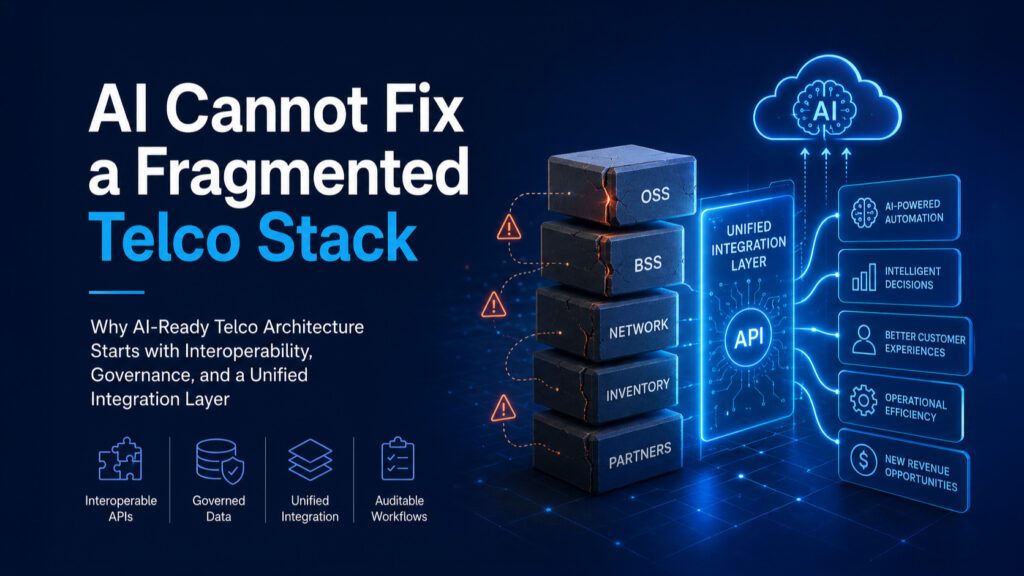
AI Cannot Fix a Fragmented Telco Stack
Artificial intelligence has become one of the biggest priorities for communications service providers (CSPs). From predictive network assurance and intelligent service orchestration to customer experience optimization and revenue management, AI is reshaping how telecom operators approach digital transformation.
The business case is compelling. AI promises faster operations, better customer experiences, lower operational costs, and new opportunities for service innovation.
Yet despite growing investment, many AI initiatives struggle to move beyond pilot projects.
The challenge is rarely the AI model itself.
Instead, the biggest barrier is the architecture that AI depends on.
Many telecom environments still rely on fragmented OSS/BSS systems, disconnected data sources, and years of custom point-to-point integrations. Without an AI-ready telco architecture, AI cannot consistently access trusted information or execute workflows across the business.
Rather than eliminating operational complexity, AI simply accelerates it.
Before organisations invest in increasingly sophisticated AI capabilities, they must first establish the architectural foundation that allows AI to operate effectively at enterprise scale.
What Is an AI-Ready Telco Architecture?
An AI-ready telco architecture is a standards-based technology foundation that enables artificial intelligence to securely access trusted data, orchestrate workflows across OSS/BSS environments, and automate business processes through interoperable APIs and unified integration layers.
Instead of operating as isolated systems, customer channels, business applications, network platforms, and partner ecosystems work together through standardized interfaces and governed data flows.
An AI-ready architecture enables telecom operators to:
- Automate service fulfilment with confidence.
- Improve decision-making using trusted operational data.
- Deliver intelligent customer experiences.
- Accelerate service innovation.
- Scale AI initiatives across multiple business domains.
- Support ecosystem-led digital transformation.
Without this foundation, even the most advanced AI models struggle to produce reliable, repeatable outcomes.
Why AI Projects Stall in Telecom
Across the telecom industry, organisations are investing in AI to improve virtually every aspect of their operations.
Common use cases include:
- Predictive network assurance
- Intelligent customer support
- Automated service provisioning
- Revenue assurance
- Fraud detection
- Workforce optimisation
- Network planning and optimisation
The technology has matured rapidly.
Large language models are becoming more capable, cloud infrastructure is widely available, and enterprise AI platforms continue to evolve.
However, many telecom organisations encounter the same obstacle after successful proof-of-concept projects.
The AI performs well in controlled environments but struggles in production.
The underlying issue is not intelligence.
It is interoperability.
Legacy OSS/BSS environments have evolved over decades. Customer management, billing, inventory, service orchestration, product catalogues, assurance platforms, and partner systems often operate independently with different data models, interfaces, and business rules.
When AI attempts to consume information from these fragmented systems, it receives inconsistent context, incomplete data, and disconnected workflows.
The result is slower deployments, unreliable automation, and AI initiatives that fail to scale across the organisation.
Why Fragmented OSS/BSS Systems Limit AI
Artificial intelligence is only as reliable as the information it consumes and the systems it can influence.
A typical telecom environment includes numerous operational platforms, including:
- Customer Relationship Management (CRM)
- Billing platforms
- Product catalogues
- Configure, Price, Quote (CPQ) systems
- Order management
- Service orchestration
- Network inventory
- Service inventory
- Assurance platforms
- Partner portals
Each platform often maintains its own identifiers, data structures, workflows, and update schedules.
As a result:
- Customer records become duplicated.
- Product definitions differ between systems.
- Inventory data becomes inconsistent.
- Service status cannot always be verified.
- Operational workflows lose end-to-end visibility.
These inconsistencies directly affect AI performance.
Imagine an AI recommendation engine using three inventory systems that report different network availability.
Or an AI-powered fulfilment workflow attempting to automate provisioning without accurate activation status.
Or a virtual assistant relying on outdated billing information because customer data is spread across multiple disconnected applications.
These scenarios are not failures of artificial intelligence.
They are failures of architecture.
AI does not solve fragmented systems.
It simply processes fragmented information faster.
The Four Foundations of an AI-Ready Telco Architecture
Building an AI-ready telco architecture is not about replacing every legacy system. It is about creating a technology foundation that enables AI to operate consistently across existing OSS/BSS environments.
Communications service providers that successfully scale AI typically invest in four foundational capabilities.
Interoperable APIs Across OSS/BSS Domains
AI depends on seamless access to business capabilities. If every new application requires a custom integration, scaling AI quickly becomes expensive and operationally complex.
Instead of relying on point-to-point integrations, modern telecom platforms expose standardized, governed APIs that enable systems to communicate consistently.
Industry frameworks such as TM Forum Open APIs, MEF Lifecycle Service Orchestration (LSO), and CAMARA Network APIs provide common integration patterns that reduce complexity while improving interoperability.
A standards-based API strategy allows telecom operators to:
- Simplify integration across OSS/BSS platforms.
- Accelerate onboarding of new partners and vendors.
- Reduce long-term maintenance costs.
- Improve data consistency across business systems.
- Enable AI services to reuse existing business capabilities instead of building new integrations for every use case.
As AI adoption grows, interoperable APIs become the foundation for scalable automation.
Governed Data with Complete Lineage
Artificial intelligence cannot create trustworthy insights from unreliable data.
For AI to support operational and commercial decisions, organisations must understand:
- Where data originates.
- How data has been transformed.
- Which systems own the data.
- Who has access to it.
- When it was last validated.
Without strong data governance, every AI recommendation carries uncertainty.
This may be acceptable for exploratory analytics, but it becomes a significant risk when AI begins influencing customer interactions, pricing decisions, network operations, or automated service fulfilment.
Trusted AI starts with trusted data.
A Unified Integration Layer
Replacing decades of OSS/BSS investments is rarely realistic.
Instead, successful telecom transformation programmes introduce a unified integration layer that connects existing platforms while abstracting legacy complexity.
This integration layer serves as the platform spine for AI-enabled operations by connecting:
- Customer experience platforms
- Product catalogues
- Configure, Price, Quote (CPQ)
- Order management
- Service orchestration
- Inventory management
- Assurance systems
- Partner ecosystems
Rather than creating additional point-to-point integrations, a unified platform enables information to flow consistently across the organisation.
For AI, this provides a single operational context instead of requiring access to dozens of disconnected systems.
Auditable Workflow Orchestration
AI-powered automation must remain transparent.
When AI recommends a pricing adjustment, provisions a service, or initiates a network workflow, organisations need complete visibility into how that decision was made.
An AI-ready telco architecture should support:
- End-to-end workflow visibility
- Decision traceability
- Input validation
- Exception handling
- Audit trails
- Policy-based governance
Observability is essential for building trust in AI-driven operations.
Without governance, automation can introduce operational and regulatory risk. With governed orchestration, AI becomes a reliable operational capability rather than an unpredictable black box.
The Business Risks of Ignoring Architecture Readiness
Many telecom organisations are eager to accelerate AI adoption, but deploying AI before addressing architectural challenges often leads to disappointing results.
Common business risks include:
Pilot-to-Production Gaps
AI performs well in controlled environments but struggles to access production data consistently, preventing enterprise-wide deployment.
Growing Integration Debt
Each new AI initiative requires additional custom integrations, increasing implementation costs and slowing future innovation.
Reduced Confidence in AI
When AI produces inconsistent recommendations because underlying systems provide conflicting information, business users quickly lose trust in automated decision-making.
Governance and Compliance Challenges
AI-driven decisions that cannot be explained, validated, or audited create operational, commercial, and regulatory risk.
Slower Innovation
Engineering teams spend more time maintaining integrations than developing new products, improving customer experiences, or launching revenue-generating services.
These challenges are architectural—not algorithmic.
How CloudSmartz Enables AI-Ready Telco Architecture
CloudSmartz helps communications service providers modernise the technology foundation that AI depends on.
Rather than replacing existing OSS/BSS investments, the Acumen360 platform creates a standards-aligned integration layer that connects business systems, network operations, and partner ecosystems into a unified architecture.
This approach enables telecom operators to modernise incrementally while preparing their organisations for enterprise-scale AI adoption.
A Unified Platform for Intelligent Operations
Acumen360 combines several core capabilities into a single connected platform, including:
- Acumen UXP for digital customer experiences
- Acumen CPQ for intelligent product configuration and quoting
- Acumen SDX for service orchestration and fulfilment
- Carrier Connect for standards-based API integration
- API Marketplace for secure API governance and monetisation
- Observability Manager for operational visibility and performance monitoring
Together, these capabilities create a unified platform that supports interoperability, automation, and AI-driven operations across the telecom value chain.
Standards-Based Integration by Design
CloudSmartz builds around recognised industry standards rather than proprietary integrations.
Support for TM Forum Open APIs, MEF principles, and modern API-first architectures helps telecom operators reduce integration complexity while improving long-term flexibility.
This standards-based approach enables organisations to connect existing systems, expose reusable business capabilities, and prepare their platforms for future AI initiatives without rebuilding their technology stack.
Building the Foundation for AI Success
Artificial intelligence has the potential to transform every aspect of telecommunications.
However, successful AI adoption begins long before the first model is deployed.
It begins with architecture.
Communications service providers that invest in interoperable APIs, governed data, unified integration, and observable workflows create an environment where AI can deliver measurable business value.
By establishing these foundations, telecom operators can:
- Accelerate AI adoption across business functions.
- Reduce integration complexity.
- Improve operational efficiency.
- Deliver more consistent customer experiences.
- Support ecosystem-led innovation.
- Future-proof technology investments.
The fastest path to AI success is not deploying a larger model.
It is building a stronger foundation.
The Bottom Line
AI cannot fix fragmented OSS/BSS systems.
Without interoperable architecture, governed data, and unified integration, even the most advanced AI models will struggle to deliver reliable outcomes.
An AI-ready telco architecture provides the operational foundation that enables intelligent automation, scalable innovation, and long-term business agility.
CloudSmartz helps communications service providers modernise that foundation through standards-based platforms, API-driven integration, and intelligent orchestration—creating telecom environments that are ready not only for today’s AI initiatives but for tomorrow’s innovations as well.
Frequently Asked Questions
What is an AI-ready telco architecture?
An AI-ready telco architecture is a standards-based technology foundation that enables artificial intelligence to securely access trusted data, orchestrate workflows across OSS/BSS environments, and automate business processes through interoperable APIs. It combines unified integration, governed data, and scalable orchestration to support enterprise-wide AI adoption.
Why can’t AI fix fragmented OSS/BSS systems?
AI depends on accurate, consistent, and connected data to make reliable decisions. When OSS/BSS systems operate in silos with disconnected data models and custom integrations, AI simply processes inconsistent information faster. Modernising the underlying architecture is essential before AI can deliver meaningful business value.
How do TM Forum Open APIs, MEF, and CAMARA support AI adoption?
TM Forum Open APIs, MEF Lifecycle Service Orchestration (LSO), and CAMARA Network APIs provide standardized interfaces that improve interoperability across telecom platforms. These standards reduce integration complexity, improve data consistency, and make it easier for AI applications to access business capabilities across OSS/BSS environments.
Why is a unified integration layer important for telecom AI?
A unified integration layer connects customer experience platforms, OSS/BSS systems, service orchestration, inventory, and partner ecosystems through standardized interfaces. This gives AI a single, trusted operational context instead of relying on multiple disconnected systems, enabling more reliable automation and faster innovation.
How does CloudSmartz help telecom operators become AI-ready?
CloudSmartz helps communications service providers build AI-ready telco architecture through the Acumen360 platform. By combining standards-based API integration, unified orchestration, digital sales, observability, and API governance, CloudSmartz enables operators to modernize existing OSS/BSS environments and create a scalable foundation for enterprise AI.

2 Responses