

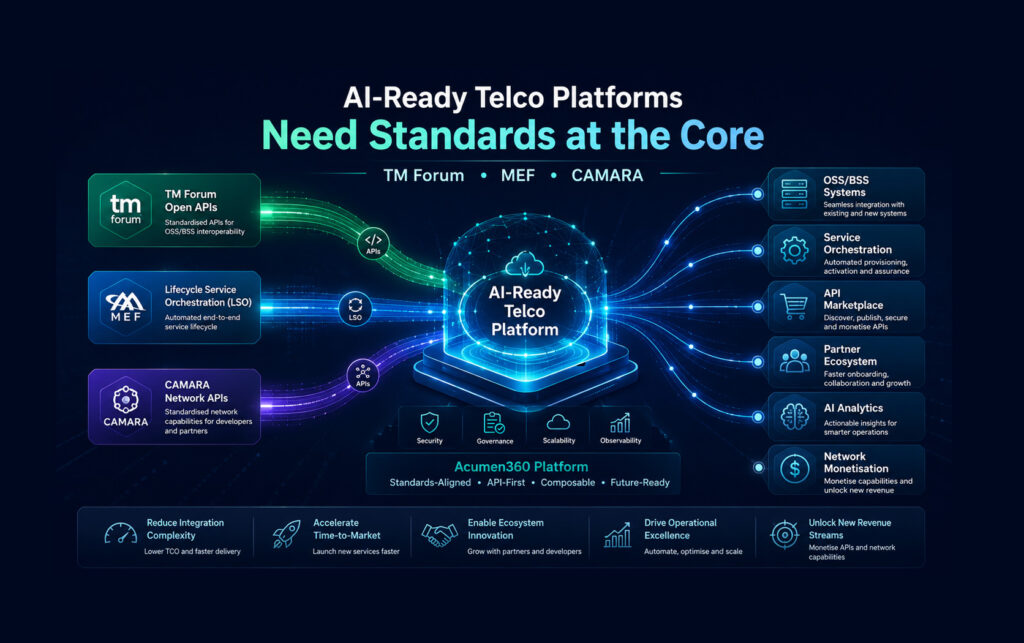
AI-Ready Telco Platforms Need Standards at the Core
Why Standards Matter for AI-Ready Telco Platforms
AI-ready telco platforms are rapidly becoming a strategic priority for communications service providers (CSPs). As operators modernise OSS/BSS environments, introduce automation, and prepare for AI-driven operations, the underlying architecture must support interoperability, scalability, and ecosystem collaboration.
Yet many transformation initiatives continue to focus primarily on deploying new capabilities rather than establishing the standards that enable those capabilities to scale. New applications are introduced, APIs are created, and integrations are built. Within a few years, complexity begins to re-emerge because interoperability was never designed into the foundation.
For telcos investing in digital transformation, standards-based architecture is no longer optional. It is a prerequisite for building platforms that can support automation, orchestration, partner ecosystems, and future AI initiatives.
What Is an AI-Ready Telco Platform?
An AI-ready telco platform is a standards-based architecture that enables data interoperability, API-driven automation, and seamless integration across OSS, BSS, network, and partner ecosystems.
These platforms provide the foundation required for:
- AI-powered operations
- Service orchestration
- Customer experience transformation
- Digital service monetisation
- Ecosystem-driven innovation
Without standardised interfaces and data models, AI initiatives often become isolated projects that struggle to scale across the organisation.
The Cost of Non-Standard Telecom Architectures
When APIs, workflows, and data models are implemented without alignment to industry standards, technical debt accumulates quickly.
For CSPs, adopting TM Forum standards reduces integration complexity while increasing vendor flexibility. Instead of creating proprietary interfaces for every new application, operators can leverage standardised APIs that accelerate deployment and simplify ongoing maintenance.
As digital transformation programmes mature, TM Forum compliance is increasingly becoming a baseline requirement for new platforms and technology investments.
MEF LSO: Enabling Automated Service Orchestration
While TM Forum focuses heavily on OSS/BSS integration, MEF’s Lifecycle Service Orchestration (LSO) framework addresses automation across service delivery and assurance workflows.
MEF standards define how carriers, partners, and service providers exchange information across the service lifecycle, including:
- Product quoting
- Service ordering
- Fulfilment
- Provisioning
- Service activation
- Assurance and support
For wholesale providers, global carriers, data centre operators, and network service providers, MEF LSO plays a critical role in reducing operational friction and enabling multi-operator automation.
As network services become increasingly dynamic and on-demand, MEF-aligned orchestration frameworks help eliminate manual processes while accelerating service delivery.
CAMARA APIs: Unlocking Network Monetisation Opportunities
The emergence of CAMARA represents one of the most significant developments in telecom API standardisation.
Backed by the Linux Foundation, GSMA, and leading global operators, CAMARA provides a standardised framework for exposing network capabilities as developer-friendly APIs.
Examples include:
- Device location verification
- Number verification
- SIM swap detection
This allows telecom providers to treat APIs as commercial products rather than simply technical interfaces.
Acumen360: A Unified Standards-Aligned Foundation
Together with Acumen SDX, Acumen CPQ, and Acumen UXP, the Acumen360 platform provides a unified foundation for:
- Digital sales
- Product catalogue management
- Configure-Price-Quote (CPQ)
- Service orchestration
- Fulfilment automation
- Service assurance
- Partner ecosystem management
The result is a standards-aligned architecture designed to scale with future business and technology requirements.
Building Future-Ready Telco Platforms with Acumen360
Future-ready telecom platforms must support more than operational efficiency.
They must enable rapid ecosystem integration, simplify partner onboarding, accelerate service delivery, and provide the flexibility required to adopt emerging technologies.
By leveraging standards-based architectures, CSPs can:
- Reduce integration costs and technical debt
- Accelerate deployment of new services
- Improve interoperability across OSS/BSS environments
- Enable ecosystem-led innovation
- Support AI and automation initiatives at scale
- Create new API monetisation opportunities
- Improve agility across wholesale, enterprise, and retail operations
Standards provide the consistency required to scale innovation without increasing complexity.
The Bottom Line
AI-ready telco platforms require more than modern user interfaces, orchestration engines, and analytics tools. They require standards-based foundations that support interoperability, automation, and ecosystem growth.
Integration costs increase because every new vendor, partner, or business unit requires custom development. Product catalogues become difficult to synchronise across systems. Service ordering and fulfilment processes become fragmented. Engineering teams spend more time maintaining integrations than delivering innovation.
The impact extends beyond IT operations.
For operators serving enterprise, wholesale, mobile, and fixed-line markets, fragmented platforms directly affect time-to-market, partner onboarding, service delivery efficiency, and customer experience. What begins as a technical challenge ultimately becomes a commercial constraint.
Common Consequences of Non-Standard Architectures
- Increased integration overhead
- Higher operational costs
- Slower onboarding of partners and vendors
- Reduced agility when launching new services
- Difficulty scaling automation initiatives
- Greater risk of vendor lock-in
- Delayed time-to-revenue
As telecom ecosystems continue to expand, the ability to integrate quickly and consistently becomes a competitive advantage.
TM Forum Open APIs: The Foundation of OSS/BSS Interoperability
TM Forum Open APIs have become the de facto standard for modern telecom platform integration.
Covering areas such as:
- Product catalogues
- Customer management
- Product ordering
- Billing
- Inventory management
- Service orchestration
TM Forum APIs provide a common language for OSS/BSS interoperability.
- Quality-on-demand
- Network insights
- Fraud prevention capabilities
These capabilities can be packaged and consumed through common API frameworks, creating new monetisation opportunities for telecom operators.
As 5G, edge computing, and Network-as-a-Service (NaaS) models continue to evolve, CAMARA is expected to play a central role in enabling ecosystem-led innovation.
How CloudSmartz Enables Standards-Based Telecom Transformation
CloudSmartz embeds standards alignment directly into the architecture of the Acumen360 platform.
Rather than treating standards as a compliance exercise, CloudSmartz positions them as a foundational design principle that enables long-term scalability, interoperability, and innovation.
Carrier Connect: Simplifying API Integration
Carrier Connect serves as a universal API integration and translation framework that simplifies connectivity across:
- OSS platforms
- BSS environments
- Partner ecosystems
- Third-party applications
- Carrier networks
By supporting industry-standard integration models, Carrier Connect helps reduce custom development while accelerating onboarding and ecosystem participation.
API Marketplace: Turning APIs into Products
CloudSmartz also provides an API Marketplace that enables operators to:
- Catalogue APIs
- Secure API access
- Govern API usage
- Manage API versioning
- Package APIs commercially
- Monetise network capabilities
TM Forum, MEF, and CAMARA provide the architectural frameworks that enable telecom operators to modernise with confidence while reducing integration friction and future-proofing their technology investments.
The question is no longer whether standards should be part of a transformation strategy. The question is whether they are being treated as a foundational workstream or an afterthought.
CloudSmartz helps communications service providers embed standards at the core of platform modernisation—creating architectures that are ready for AI, prepared for ecosystem-led growth, and built to scale.
Ready to Discuss Standards-Led Modernisation?
Whether you’re modernising OSS/BSS systems, building API-driven ecosystems, or preparing your organisation for AI-enabled operations, CloudSmartz can help.
Learn how Acumen360, Carrier Connect, and our standards-first approach can accelerate your telecom transformation journey.
Get in touch with the CloudSmartz team today.

3 Responses