

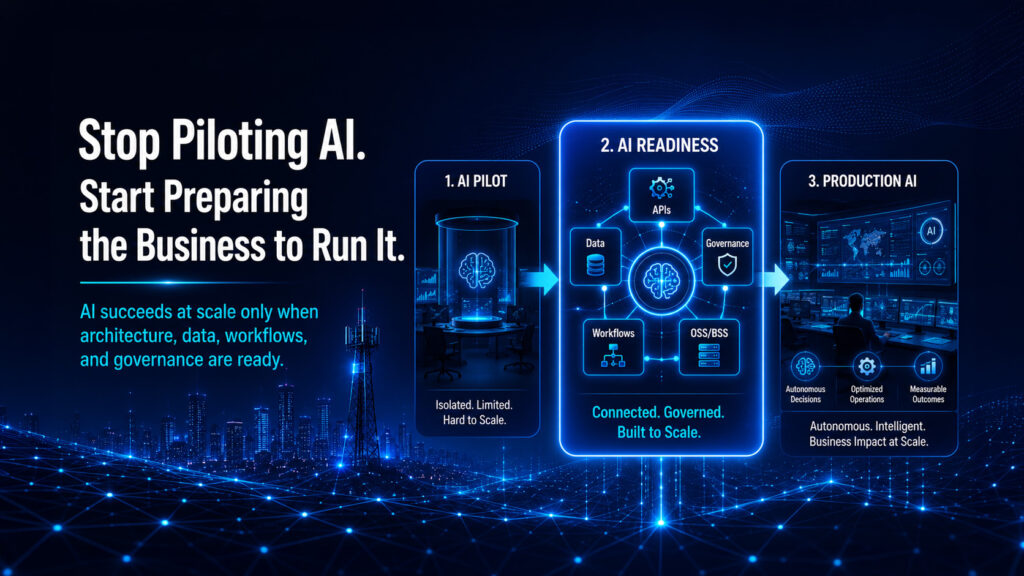
Stop Piloting AI. Start Preparing the Business to Run It.
Artificial intelligence is no longer a future initiative for telecom operators. Across the industry, communications service providers (CSPs) are investing in AI to improve network operations, automate service fulfilment, enhance customer experiences, optimize pricing, and reduce operational costs.
Yet despite significant investment, relatively few AI initiatives progress beyond pilot projects.
The challenge is rarely the AI model itself. Modern AI platforms are more capable and accessible than ever. The real challenge is whether the business is prepared to operationalize AI at scale.
Successful AI adoption depends on more than choosing the right technology. It requires modern architecture, trusted data, governed APIs, automated workflows, and a structured roadmap that enables AI to operate across the business.
Why Most AI Pilots Never Reach Production
AI pilots are designed to validate an idea within a controlled environment.
Typically, they involve a limited dataset, a small group of users, a single workflow, and a dedicated project team. Under these conditions, pilots often demonstrate impressive results.
The real challenge begins when organizations attempt to deploy the same solution across their operational environment.
Production AI must work across multiple OSS/BSS platforms, CRM systems, inventory databases, billing applications, partner ecosystems, and customer channels. It must consume governed data, integrate with existing workflows, comply with regulatory requirements, and produce consistent outcomes every day.
This is where many pilots fail—not because the AI is ineffective, but because the surrounding business environment is not ready to support it.
Common barriers include:
- Fragmented OSS/BSS environments
- Inconsistent or poor-quality data
- Limited API availability
- Manual operational workflows
- Weak governance and ownership
- Poor prioritization of AI use cases
These issues create an operational readiness gap that prevents promising pilots from becoming scalable business capabilities.
Moving beyond experimentation requires a structured AI readiness programme rather than another proof of concept.
What Is an AI Readiness Programme?
An AI readiness programme is a structured approach to preparing the people, processes, systems, and data that AI depends on.
Instead of focusing solely on selecting AI models or vendors, it evaluates whether the organization has the operational foundation required for AI to deliver measurable business outcomes.
A comprehensive readiness programme helps telecom operators:
- Assess the maturity of existing architecture
- Improve data quality and governance
- Modernize integration through APIs
- Automate operational workflows
- Prioritize high-value AI use cases
- Create a phased roadmap for implementation
Most importantly, it shifts AI from being an isolated innovation initiative to becoming part of the organization’s long-term digital transformation strategy.
The goal is not to deploy AI faster.
The goal is to deploy AI successfully.
The Four Pillars of an AI Readiness Programme
Preparing a telecom organization for AI requires improvements across multiple operational domains.
While every operator starts from a different level of maturity, successful AI programmes consistently focus on five core pillars.
Architecture Readiness
Every AI application depends on access to business systems.
If critical capabilities remain trapped inside tightly coupled legacy applications or disconnected OSS/BSS environments, AI cannot operate effectively regardless of how sophisticated the model may be.
Architecture readiness begins by assessing whether systems expose their capabilities through secure, governed, and scalable APIs.
Key questions include:
- Can AI securely access operational data?
- Are APIs standardized and well governed?
- Are integrations reusable or still point-to-point?
- Can new AI services be deployed independently?
- Where does technical debt limit modernization?
The objective is not to replace existing systems overnight.
Instead, organizations should identify the architectural improvements that remove the biggest barriers to future AI adoption while continuing to support current business operations.
Modern API-first architecture also delivers immediate benefits beyond AI by simplifying integrations, accelerating partner onboarding, and reducing long-term technical debt.
Data Readiness
AI is only as reliable as the data it consumes.
Many telecom operators store customer, service, inventory, and operational data across numerous platforms that have evolved independently over many years.
As a result, the same business entity may exist in multiple systems with conflicting information, inconsistent naming conventions, or different update frequencies.
Before deploying AI at scale, organizations should evaluate whether their data is:
- Accurate
- Consistent
- Timely
- Governed
- Traceable
- Secure
Data readiness also involves understanding ownership and accountability.
Every critical dataset should have clearly defined owners, quality standards, governance policies, and lifecycle management processes.
Investing in data readiness may require time, but it creates lasting value far beyond AI by improving reporting, operational visibility, customer experience, and business decision-making.
Workflow Readiness
Generating AI insights is only part of the equation.
The real value comes when those insights trigger business actions.
For example, an AI model may identify a network anomaly, recommend a pricing adjustment, predict customer churn, or detect an order exception.
However, if employees must manually copy information between systems, approve every recommendation through email, or re-enter data into downstream applications, the efficiency gains quickly disappear.
Workflow readiness focuses on evaluating whether business processes can support AI-driven automation.
Organizations should assess:
- Which workflows are already automated
- Where manual handoffs still exist
- Whether orchestration platforms can execute AI-driven actions
- How exceptions are handled
- Where human approvals remain necessary
- Whether every action can be monitored and audited
AI should become part of an operational workflow—not another disconnected dashboard.
The more mature the workflow automation, the greater the business value AI can deliver.
AI Governance and Use-Case Prioritization
Not every AI idea deserves immediate investment.
One of the most common reasons organizations struggle with AI adoption is attempting too many disconnected initiatives without evaluating their operational readiness or business impact.
A structured governance framework helps organizations prioritize AI opportunities based on measurable value rather than hype.
Effective evaluation considers factors such as:
- Business outcomes
- Technical feasibility
- Data availability
- Integration complexity
- Implementation effort
- Operational risk
- Expected return on investment
This approach ensures resources are directed toward initiatives that can realistically be deployed and scaled.
Strong governance also establishes ownership, success metrics, compliance requirements, and ongoing oversight throughout the AI lifecycle.
Rather than chasing the latest AI trend, telecom operators can build a balanced portfolio of initiatives that deliver incremental value while supporting long-term transformation.
Building an AI Execution Roadmap
A successful AI readiness programme does not attempt to modernize everything at once. Instead, it follows a phased roadmap that delivers immediate business value while laying the foundation for future AI adoption.
The objective is to identify the improvements that unlock the greatest number of AI use cases while minimizing operational risk and disruption.
A practical execution roadmap should answer questions such as:
- Which readiness initiatives will deliver the fastest business value?
- Which architecture improvements enable multiple future AI use cases?
- Which legacy dependencies present the greatest operational risk?
- How should investment be sequenced across quarters?
- Who owns governance, funding, and delivery?
Rather than viewing readiness as a one-time exercise, organizations should treat it as an ongoing capability that evolves alongside business priorities and technology investments.
What an AI Readiness Programme Looks Like in Practice
While every telecom operator has different priorities, most successful AI readiness programmes follow a similar progression.
Phase 1: Assess the Current Environment
The first step is understanding the current state of the business.
This includes reviewing architecture, API maturity, data quality, workflow automation, governance processes, and potential AI use cases.
During this phase, organizations should:
- Assess OSS/BSS interoperability
- Map critical data flows
- Evaluate API maturity
- Identify manual workflow bottlenecks
- Prioritize AI use cases based on business value and feasibility
- Define measurable success criteria
The outcome is a clear understanding of where readiness gaps exist and which investments should be prioritized first.
Phase 2: Strengthen the Foundation
With priorities established, organizations can begin addressing the operational barriers that prevent AI from scaling.
Typical initiatives include:
- Standardizing API exposure across OSS/BSS
- Improving data quality and governance
- Automating high-value operational workflows
- Implementing orchestration capabilities
- Establishing AI governance and ownership
- Reducing integration complexity
These improvements provide immediate operational benefits even before AI is introduced into production.
Phase 3: Deploy Production AI
Once the foundation is in place, organizations can confidently deploy their first production AI use cases.
Unlike isolated pilots, these deployments integrate directly with operational systems and business workflows.
Typical production AI applications include:
- Intelligent service assurance
- Predictive network operations
- AI-assisted customer support
- Quote optimization
- Order validation
- Revenue assurance
- Incident prioritization
Because the supporting architecture has already been prepared, organizations spend less time solving integration problems and more time delivering measurable business outcomes.
Phase 4: Scale Across the Enterprise
AI readiness is not a destination.
As new services, channels, partners, and technologies emerge, organizations should continuously extend their readiness programme.
This includes:
- Expanding API coverage
- Improving data governance
- Automating additional workflows
- Monitoring AI performance
- Measuring business outcomes
- Refining governance policies
- Prioritizing new AI opportunities
Over time, AI becomes an operational capability rather than a collection of disconnected projects.
What We Learned Throughout the AI-Ready OSS/BSS Series
This series has explored one central idea:
Successful AI adoption begins long before selecting an AI model.
Each article examined a different aspect of the operational foundation required for AI success.
Together, they form a practical roadmap for telecom modernization.
- Phased Modernization Beats Rip-and-Replace demonstrated why incremental transformation reduces risk while delivering continuous business value.
- Automated Fulfilment Completes the Digital Promise showed that digital sales only create value when fulfilment workflows are equally digital.
- Standards at the Core explained how TM Forum Open APIs, MEF, and CAMARA reduce integration complexity and improve interoperability.
- AI Cannot Fix a Fragmented Telco Stack highlighted why fragmented systems, inconsistent data, and disconnected workflows prevent AI from delivering meaningful outcomes.
- AI Readiness Beats AI Hype reinforced that operational readiness—not model selection—determines long-term AI success.
- Waiting for the Perfect AI Stack Is the Real Risk demonstrated why delaying foundational modernization only increases future complexity and technical debt.
Finally, this article brings those ideas together into a practical AI readiness programme that organizations can use to assess, prioritize, and execute their transformation journey.
The message remains consistent throughout the series:
Readiness is not a prerequisite for AI. It is the strategy that enables AI to create lasting business value.
How CloudSmartz Helps Telecom Operators Move Beyond AI Pilots
CloudSmartz helps communications service providers transition from isolated AI experiments to scalable, production-ready AI capabilities.
Our approach focuses on strengthening the operational foundation that AI depends upon rather than introducing technology in isolation.
This includes:
- AI readiness assessments across architecture, data, workflows, governance, and integration maturity
- Design and Prototype Services that validate high-value AI use cases before full-scale implementation
- API-first integration and Custom Development & System Integration that modernize existing OSS/BSS environments without wholesale replacement
- The Acumen360 platform, providing a unified orchestration layer across customer experience (UXP), CPQ, Service Delivery (SDX), Observability, and partner ecosystems
- AI Enablement capabilities that help organizations deploy governed, explainable, and scalable AI solutions
By combining telecom domain expertise with standards-based architecture, CloudSmartz enables operators to modernize at their own pace while building an environment where AI can deliver measurable business outcomes.
AI Success Starts with Readiness
Telecom operators do not need more AI pilots.
They need stronger operational foundations that allow AI to move confidently into production.
Organizations that invest in architecture modernization, trusted data, API governance, workflow automation, and structured execution planning will be better positioned to scale AI across commercial and operational functions.
Those that continue to treat AI as a series of disconnected experiments risk increasing technical debt, delaying transformation, and limiting long-term value.
AI is not the destination.
Operational readiness is what turns AI into a sustainable business capability.
Ready to move beyond AI pilots? Contact CloudSmartz to assess your AI readiness and build a practical roadmap for scalable AI adoption.
Frequently Asked Questions
What is an AI readiness programme?
An AI readiness programme is a structured framework that evaluates whether an organization has the architecture, data, governance, workflows, and operational processes required to successfully deploy AI at scale.
Why do AI pilots often fail to reach production?
Most AI pilots succeed in controlled environments but struggle in production because of fragmented systems, inconsistent data, limited API access, manual workflows, and weak governance. Addressing these operational challenges is essential for scalable AI adoption.
What are the five pillars of AI readiness?
The five pillars of AI readiness are architecture readiness, data readiness, workflow readiness, AI governance and use-case prioritization, and a phased execution roadmap that guides implementation.
Why is API governance important for AI?
AI applications rely on secure and consistent access to operational data. Well-governed APIs improve interoperability, simplify integration, enhance security, and enable AI to interact reliably with OSS/BSS and enterprise systems.
How can telecom operators prepare for AI adoption?
Telecom operators should begin by assessing their architecture, improving data quality, modernizing APIs, automating workflows, prioritizing high-value AI use cases, and implementing governance frameworks that support long-term AI deployment.
How does CloudSmartz help telecom operators become AI-ready?
CloudSmartz helps telecom operators assess AI readiness, modernize OSS/BSS environments, improve interoperability, automate workflows, and deploy AI on a governed, standards-based foundation through Acumen360, AI Enablement capabilities, and Custom Development & System Integration services.