

Telecom Service Automation: Why Digital Sales Mean Very Little Without Automated Delivery
Introduction
The last several years have produced an impressive wave of digital investment across the telecom industry. Customer portals, self-service buying journeys, AI-guided CPQ, and other digital transformation initiatives have made the commercial front-end of a modern CSP more capable than ever.
But digital sales success and telecom service automation must go hand in hand.
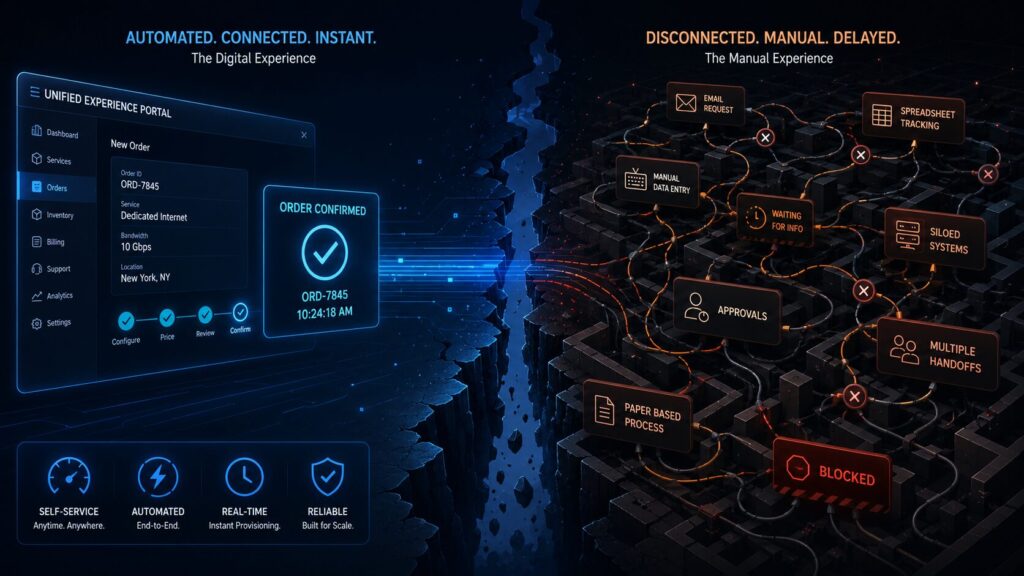
For too many communications service providers (CSPs), digital transformation has become a half-transformation—polished at the point of sale but reverting to manual, fragmented fulfilment the moment an order is submitted. Customers buy in seconds. Activation takes days.
The gap between those two experiences is where customer satisfaction, operational cost, and competitive positioning are quietly decided.
The Telecom Service Automation Gap in Digital Transformation
When CSPs invest in digital channels—customer portals, self-service marketplaces, and CPQ tooling—the business case is typically built around commercial outcomes:
- Faster time-to-quote
- Increased self-service transactions
- Lower cost of sale
- Improved customer experience
These benefits are real and valuable.
What often receives less attention is what happens after an order is placed.
In many CSP environments, service fulfilment remains heavily manual. Orders enter ticketing systems and are manually picked up by engineers. Provisioning flows through siloed OSS/BSS environments, with human intervention required at multiple stages.
Typical Activities in Manual Fulfilment
- Network configuration
- Service provisioning
- Service testing
- Customer notification
Each activity is frequently managed by different teams using different tools.
The result is a delivery engine that looks nothing like the digital front-end positioned in front of customers. Enterprise buyers increasingly benchmark experiences against cloud-native service providers, making the disconnect immediately visible.
The front-end promise and back-end reality are no longer compatible.
Where the Operational Gap Appears in Telecom Fulfilment
The consequences of disconnected digital sales and fulfilment are well understood by COOs, CTOs, and service delivery leaders.
Common Operational Challenges
- High order fallout rates
- Manual rework cycles
- Delayed service activation
- Increased operational costs
- SLA performance risks
Every fallout event creates additional work:
- Investigation
- Correction
- Resubmission
- Manual coordination
As product portfolios expand, the problem grows more complex.
Why Complexity Continues to Increase
Each service introduces:
- New configuration requirements
- Additional domain dependencies
- More OSS/BSS touchpoints
- Greater operational complexity
Without service orchestration, manual effort scales alongside service complexity.
CTOs and Product Operations teams face an additional challenge: integration debt.
Every new capability often requires point-to-point integrations that are:
- Costly to build
- Difficult to maintain
- Vulnerable to failure
Across OSS/BSS environments shaped by years of acquisitions, modernization efforts, and platform changes, delivery organizations frequently absorb the complexity that digital transformation initiatives were intended to remove.
What Automated Service Delivery Looks Like
Closing the gap requires a service orchestration layer between the commercial front-end and the network.
Rather than treating an order as a handoff to a queue, telecom service automation treats it as the beginning of an automated fulfilment sequence.
Acumen360 SDX was designed for this purpose.
The platform automates service orders and multi-domain activation through a MEF/TMF-aligned, vendor-neutral orchestration engine. Orders triggered from digital channels enter predefined activation workflows immediately, eliminating the need for manual relay processes.
Key Capabilities of Automated Service Delivery
- Automated service order management
- Multi-domain activation
- Real-time provisioning
- Service orchestration workflows
- SLA visibility and monitoring
Activation events move through the technology stack in sequence, rather than relying on engineer intervention to advance the process.
Real-Time Operational Visibility
Task-based workflows provide delivery teams with real-time visibility into:
- Order status
- Workflow progression
- Completed activities
- Bottlenecks and delays
Acumen360 UXP complements this approach by bringing operational systems together in a unified role-based portal.
Teams gain visibility across:
- Ticketing
- Ordering
- Provisioning
- Billing
- Network operations
This enables delivery teams, fulfilment managers, and product operations teams to work from a common operational view.
The API Connector further extends orchestration by integrating with legacy OSS/BSS environments through standardized APIs, helping organizations automate service delivery without replacing existing infrastructure.
Operational Outcomes of Telecom Service Automation
The benefits of automated service delivery become measurable early in deployment.
Customer care teams using the Acumen360 platform have realized upwards of 40% cost savings through self-service automation.
Organizations combining Acumen360 CPQ and SDX have achieved up to a 50% improvement in quote-to-cash performance.
With SDX’s zero-touch activation capabilities, provisioning that previously required coordination across multiple teams can be completed within the same operational window as the commercial transaction.
CSPs including Telstra and GTT have used this model to move from sequential, manual delivery processes to real-time orchestration at scale.
The activation journey progresses alongside the digital buying experience rather than lagging behind it.
Why Automated Delivery Is Essential for Digital Transformation
A portal that captures orders in minutes and a fulfilment engine that takes weeks to activate them does not represent a fully digital operation.
It represents a digital front-end supported by a manual back-end.
For communications service providers pursuing digital transformation, that distinction matters.
The automation gap is closeable without replacing the entire technology stack. By combining service orchestration, OSS/BSS integration, and telecom service automation, CSPs can align digital sales experiences with automated delivery outcomes and create a more efficient, scalable operational model.
Frequently Asked Questions
What is telecom service automation?
Telecom service automation uses orchestration and automated workflows to manage service fulfilment, provisioning, and activation with minimal manual intervention.
Why do CSPs need service orchestration?
Service orchestration coordinates processes across OSS/BSS systems and network domains, reducing delays, manual work, and operational complexity.
How does automated service delivery improve customer experience?
It shortens activation times, reduces provisioning errors, and aligns fulfilment performance with digital buying expectations.
What causes order fallout in telecom operations?
Order fallout commonly results from disconnected systems, manual processes, data inconsistencies, and complex provisioning workflows.
Can telecom automation work with legacy OSS/BSS systems?
Yes. API-based integration approaches can automate workflows while leveraging existing OSS/BSS investments.
What is zero-touch provisioning?
Zero-touch provisioning automates service activation and configuration without requiring manual intervention during fulfilment.
How does telecom service automation improve quote-to-cash processes?
By connecting sales, fulfilment, provisioning, and activation workflows, automation reduces delays and accelerates revenue realization.