

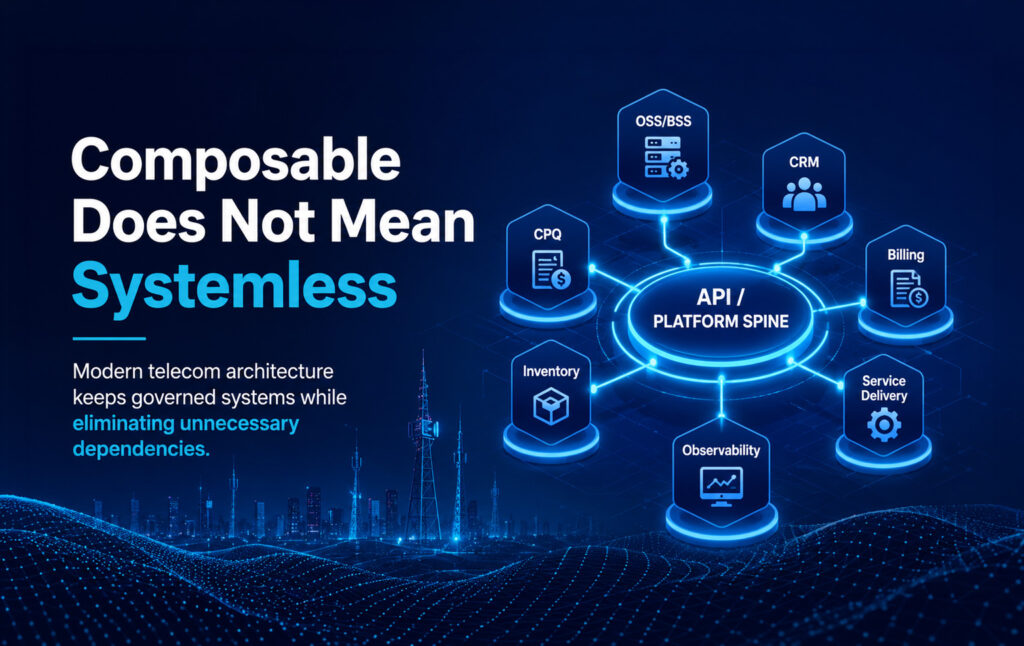
Composable Does Not Mean Systemless
There is a growing misconception in enterprise architecture that composable platforms eliminate the need for core business systems. The narrative often suggests that CRM, OSS/BSS, CPQ, billing, and orchestration will eventually disappear, replaced by lightweight microservices, headless applications, and AI agents connected through APIs.
While this sounds innovative, it overlooks the realities of running a telecommunications business.
Composable architecture is not about removing systems. It is about removing unnecessary dependencies between systems. It replaces rigid integrations with modular, standards-based connections while preserving the governed platforms that manage products, customers, services, orders, pricing, and network operations.
For telecom operators, this distinction is critical. Communications service providers operate highly regulated, complex environments where operational accountability, service assurance, and commercial governance cannot simply be distributed across hundreds of independent services.
This article is the second instalment of the Platform Spine Series. In our previous article, we explored why modern telecom operators need a unified platform spine to connect customer experience, commercial operations, fulfilment, assurance, and partner ecosystems. Here, we explain how composable architecture makes that platform spine more flexible without compromising governance or operational control.
What Is Composable Telco Architecture?
Composable telco architecture is an architectural approach that allows individual business capabilities to evolve independently while remaining connected through standardized APIs, orchestration, and shared governance.
Instead of building tightly coupled applications where every change impacts multiple downstream systems, composable architecture separates capabilities into modular components with clearly defined responsibilities.
These components communicate through governed interfaces rather than direct dependencies, allowing organizations to modernize one capability at a time instead of replacing entire platforms.
For telecom operators, this means existing investments in OSS, BSS, CRM, CPQ, billing, and fulfilment systems can continue delivering value while becoming easier to integrate, extend, and modernize.
A composable architecture typically includes:
- API-first communication between applications
- Event-driven workflows
- Modular business capabilities
- Independent deployment of services
- Centralized governance and orchestration
- Standards-based integration using frameworks such as TM Forum Open APIs, MEF, and CAMARA
The objective is not to reduce the number of systems. The objective is to reduce the complexity of how those systems work together.
Why “Composable” Does Not Mean “Systemless”
One of the biggest misconceptions surrounding composable architecture is that organizations should eliminate core enterprise systems altogether.
In reality, telecom operators still require authoritative systems that manage customer information, service inventory, commercial rules, billing, and operational workflows.
What changes is the architecture—not the business responsibility.
Instead of every platform communicating directly with every other platform, composable architecture introduces standardized APIs, orchestration, and event-driven communication that allow systems to exchange information without becoming tightly coupled.
Think of it this way.
A composable home is not built without foundations. It is built with modular rooms connected by well-designed infrastructure.
Similarly, a composable telecom platform still relies on governed systems of record and systems of action. Those systems simply become easier to integrate, upgrade, and replace because they expose standardized interfaces rather than proprietary connections.
For telecom operators pursuing digital transformation, this creates an architecture that is both adaptable and operationally resilient.
What Does Composable Architecture Replace?
Composable architecture does not eliminate business capabilities. Instead, it replaces outdated architectural patterns that make modernization expensive and risky.
Rigid System Coupling
Traditional telecom environments often rely on tightly coupled integrations between OSS, BSS, CRM, billing, inventory, and fulfilment platforms.
A small change in one application frequently requires updates, regression testing, and deployment across multiple dependent systems.
Composable architecture replaces these tightly coupled relationships with loosely coupled services connected through standardized APIs and orchestration layers.
As a result, teams can modernize individual capabilities without disrupting the broader platform.
Point-to-Point Integrations
Many legacy telecom environments contain hundreds of custom integrations built specifically for individual systems.
While these integrations may solve immediate business needs, they become increasingly difficult to maintain as the technology landscape grows.
Composable architecture replaces point-to-point integrations with centralized API management, reusable services, and event-driven communication.
This reduces integration complexity while making future system upgrades significantly easier.
Vendor Lock-In
When critical business processes depend entirely on a single vendor platform, replacing or extending that platform becomes costly and time-consuming.
Composable architecture minimizes vendor lock-in by separating business capabilities from the underlying technology implementation.
Standards-based APIs allow organizations to replace individual components without rebuilding the surrounding ecosystem.
This provides greater flexibility while protecting existing technology investments.
Slow Release Cycles
In traditional architectures, software releases often require multiple teams to coordinate changes across numerous interconnected systems.
This slows innovation and increases deployment risk.
Composable architecture enables independent deployment by allowing individual services or business capabilities to evolve without impacting unrelated systems.
Organizations can introduce new functionality faster while reducing operational disruption.
Fragile Integration Patterns
Legacy point-to-point integrations often fail when upstream or downstream systems change.
These failures are difficult to identify because dependencies are distributed across multiple applications.
Composable architecture introduces governed integration layers that improve visibility, monitoring, version control, and resilience.
Rather than every application knowing about every other application, systems interact through managed interfaces that are easier to monitor, secure, and maintain.
What Does Composable Architecture Not Replace?
Composable architecture enables flexibility, but it does not eliminate the systems that telecom operators depend on to run their business. Instead, it changes how these systems connect and evolve while preserving their core responsibilities.
Systems of Record
Every telecom operator requires authoritative systems that serve as the single source of truth for critical business domains.
These include:
- Customer information
- Product catalogues
- Service inventory
- Network inventory
- Orders
- Billing records
A composable architecture does not replace these systems. Instead, it allows them to expose governed APIs so that other applications can securely consume their data without creating direct dependencies.
For example, a product catalogue should remain the authoritative source for products, bundles, and pricing eligibility. Multiple applications may consume that information, but none should maintain competing versions of the same data.
Maintaining trusted systems of record improves data consistency, reduces reconciliation effort, and supports reliable decision-making across commercial and operational teams.
Systems of Action
Telecom services rarely involve a single transaction.
Provisioning a new enterprise circuit, activating a mobile service, or onboarding a wholesale customer often requires coordinated actions across CRM, CPQ, OSS, network inventory, fulfilment, and billing platforms.
These activities require systems of action that orchestrate complex workflows from start to finish.
Composable architecture does not eliminate orchestration engines.
Instead, it allows orchestration platforms to coordinate modular services through APIs and events rather than relying on tightly coupled integrations.
This creates greater flexibility while preserving transactional integrity, exception handling, auditability, and operational control.
Commercial Governance
Commercial operations depend on consistent business rules.
Pricing policies, discount thresholds, approval workflows, contract terms, and margin controls cannot be distributed across disconnected services without increasing operational risk.
A composable architecture keeps commercial governance centralized while allowing different applications to consume the same governed logic.
For example, whether a customer purchases through a digital portal, partner channel, or enterprise sales team, pricing and approval policies should remain consistent because they originate from the same commercial engine.
This approach improves compliance, reduces revenue leakage, and ensures consistent customer experiences across every sales channel.
Operational Accountability
One of the most overlooked aspects of composable architecture is accountability.
Every telecom operator must be able to answer questions such as:
- Which system owns SLA reporting?
- Which platform records service activation?
- Where is the audit trail for regulatory compliance?
- Which application manages incident escalation?
- Which platform provides the authoritative order status?
Composable architecture does not remove accountability.
Instead, it makes accountability clearer by allowing each platform to specialize in its domain while integrating through governed interfaces.
Operational ownership remains explicit even as the architecture becomes more modular.
What a Composable Telco Architecture Looks Like
The most successful telecom architectures combine modularity with governance rather than treating them as opposing goals.
Architecture Layer | Primary Responsibility | Composable Principle |
Experience Layer | Customer portals, partner portals, mobile apps | Composes services from backend systems through APIs |
Commercial Layer | CPQ, pricing, approvals, contracts | Modular commercial services with governed business rules |
Orchestration Layer | Fulfilment, activation, assurance | Coordinates workflows across multiple systems using APIs and events |
Domain Systems | OSS, BSS, CRM, Inventory, Billing | Remain authoritative systems of record with governed interfaces |
Integration Layer | API Gateway, Event Bus, Integration Services | Decouples systems while enforcing security, governance, and observability |
Each layer can evolve independently without disrupting the rest of the platform.
This approach reduces modernization risk while supporting continuous innovation.
Benefits of Composable Telco Architecture
Composable architecture provides tangible business value beyond technical modernization.
Key benefits include:
- Faster deployment of new digital services
- Lower integration and maintenance costs
- Reduced vendor lock-in
- Independent modernization of individual capabilities
- Improved interoperability across OSS/BSS environments
- Better scalability for future business requirements
- Simplified integration with partner ecosystems
- Greater resilience through loosely coupled services
- Stronger governance across commercial and operational processes
- A flexible foundation for AI-ready operations
Rather than replacing core systems, composable architecture extends their value while making them significantly easier to evolve.
How CloudSmartz Helps Build Composable Telecom Platforms
CloudSmartz helps communications service providers modernize their technology landscape through modular, standards-based platform architecture.
At the heart of this approach is Acumen360, an API-first platform designed to connect customer experience, commercial operations, fulfilment, observability, and partner ecosystems without requiring wholesale replacement of existing OSS/BSS investments.
Key capabilities include:
- Modular platform architecture designed for independent evolution
- API-first integration with existing OSS/BSS, CRM, and enterprise systems
- Standards alignment with TM Forum Open APIs, MEF, and CAMARA
- Unified orchestration across commercial and operational workflows
- Centralized governance for products, pricing, fulfilment, and partner management
- Custom Development & System Integration services that reduce coupling while preserving operational control
Rather than replacing existing platforms, CloudSmartz enables telecom operators to modernize incrementally, creating a composable architecture that supports continuous innovation while protecting previous technology investments.
Composable Architecture Requires Governance, Not Fewer Systems
Composable architecture is transforming how telecom platforms are designed, integrated, and modernized.
However, composability should never be confused with eliminating the systems that run the business.
OSS/BSS platforms, CRM, CPQ, billing, fulfilment, and observability remain essential because they provide operational accountability, commercial governance, and trusted business data.
What changes is how these systems communicate.
Instead of relying on tightly coupled integrations and proprietary connections, modern telecom platforms use APIs, orchestration, and event-driven communication to enable independent evolution without sacrificing governance.
Organizations that embrace this approach can modernize faster, reduce technical debt, and build an architecture that is ready for future technologies—including AI—without rebuilding their operational core.
Ready to build a composable telco architecture without compromising governance? Contact the CloudSmartz team to explore how Acumen360 can help accelerate your modernization journey.
Frequently Asked Questions
What is composable telco architecture?
Composable telco architecture is a modular approach to telecom platform design where business capabilities operate independently but connect through standardized APIs, orchestration, and shared governance. It allows operators to modernize individual systems without replacing their entire OSS/BSS environment.
Does composable architecture replace OSS/BSS?
No. Composable architecture does not replace OSS/BSS platforms. These systems continue to serve as systems of record and systems of action. The architectural change lies in how they integrate with other platforms through APIs and event-driven communication.
What are systems of record in telecom?
Systems of record are the authoritative sources of business data, including customer information, product catalogues, service inventory, network inventory, orders, and billing. They provide the trusted data foundation required for operational and commercial processes.
What are the benefits of composable architecture for telecom operators?
Composable architecture helps telecom operators reduce integration complexity, minimize vendor lock-in, accelerate service delivery, modernize incrementally, improve interoperability, and prepare their platforms for AI-driven operations without replacing existing investments.
How does composable architecture support AI readiness?
AI depends on clean data, interoperable systems, and governed workflows. A composable architecture provides standardized APIs, modular services, and consistent orchestration, making it easier for AI applications to access trusted information and automate business processes.
How does CloudSmartz help telecom operators implement composable architecture?
CloudSmartz helps telecom operators design and implement composable architectures through the Acumen360 platform, API-first integration, standards-aligned development, and Custom Development & System Integration services. This enables operators to modernize existing OSS/BSS environments while maintaining governance, operational accountability, and long-term flexibility.